
Secrets of Researcher Success 4
Problem Solving and Decision Making
“All life is problem solving.” Karl Popper
Steps in a Process
Every day we’re solving problems without needing to think much about them. But as we move on in our careers, from undergraduate, to postgraduate and beyond, the problems get bigger, longer, harder, and involve more people, and more responsibility. And because of your qualifications you’re expected to have developed skills as a problem solver, and be able to communicate to others what your strategy for solving a problem is.
Making decisions in our personal lives can be hard enough at times: we can be too hasty, or paralysed by indecision. This becomes more significant in professional work. The quality of the decisions we make, especially with others involved, determines our enjoyment, and our futures – the choices that we make, rather than the risks that we take.
In these sessions, we will follow a process through exploration of the problem, testing solutions, coming to decisions and being prepared, so attendance at all three is most beneficial.
We’ll work with something that is of interest to you and will take time to focus on these topics, look at problem solving in its wider context, decision making and the factors involved in making better quality decisions (and why we make bad decisions), as well as making sure we attend to the issues associated with other people being a significant factor in the problem arena, and decision making task.
“Thanks a lot, it was very inspirational to find new ways to think about problems in uncommon and practical ways.” Delegate, 21st Century Researcher Conference, University of Manchester.
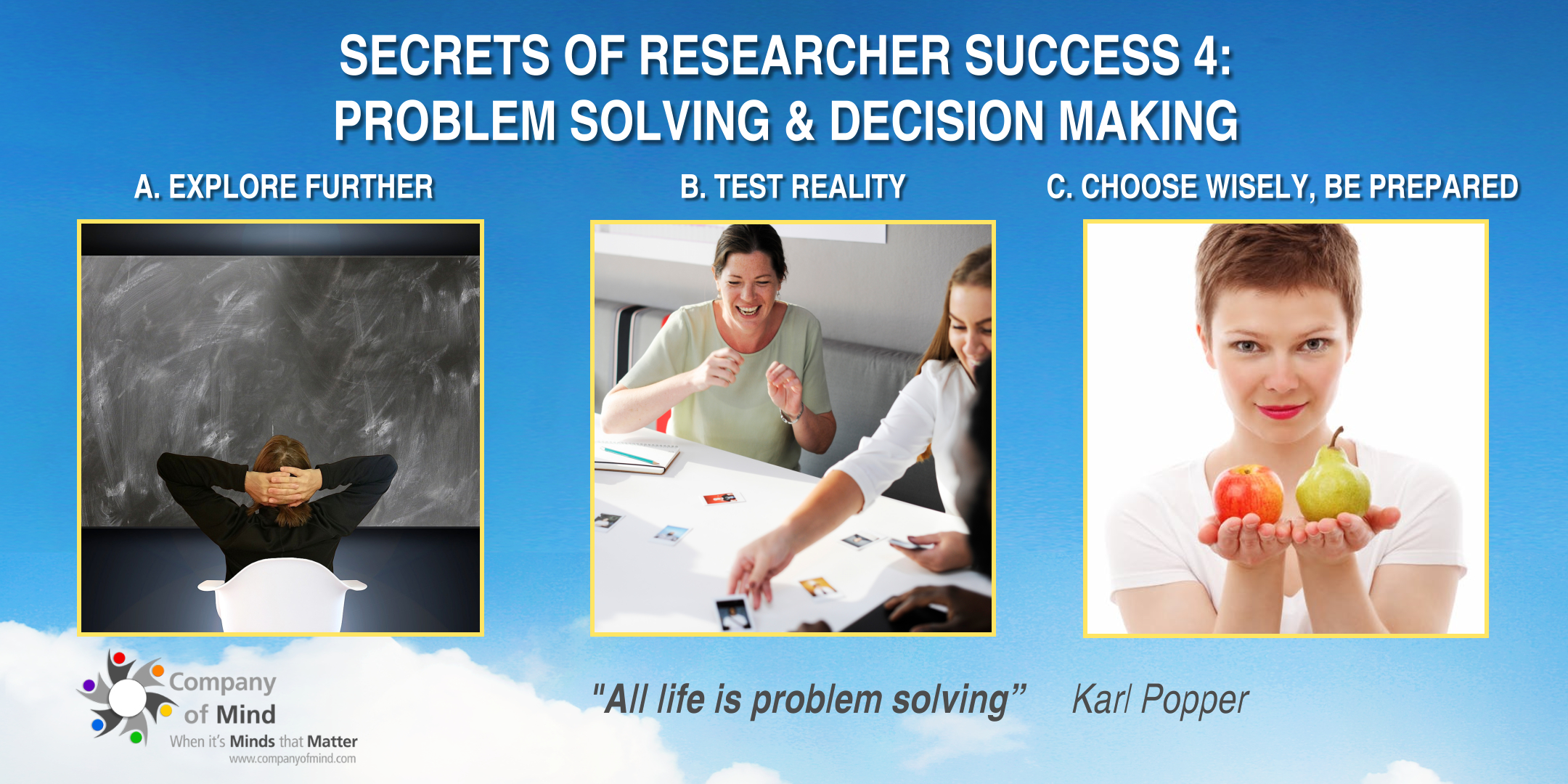
Session A – Explore Further
Time spent understanding the nature of the problem, using systematic tools and processes is invaluable and invites a range of relevant solutions more effectively. We’ll come up with a problem to try out, and work through the kinds of processes and tools we can use to explore that.
Session B – Test Reality
There are useful thinking tools which we can apply systematically to test a range of solution options we have come up with. In this way we can simulate reality, hone our thinking, and understand the consequences of those options, before we have to commit to solutions.
Session C – Choose Wisely, Be Prepared
The point of choice sets us on a path to action and commits resources. We need to make decisions all the time; for those that have greater impact where our past experience is not necessarily a good measure, it is helpful to apply methods which give us a greater degree of certainty and lead to more success. Having made decisions, we can scan ahead to ensure that the path remains clear by consciously applying methods for being prepared and monitoring progress.
These 3 Sessions are offered as stand alone components online of 2.5 hours each for up to 50 delegates, or as a 1 day face to face event for up to 25 delegates.
Skill Development
This event is suitable for Postgraduate Researchers at any stage of their research, and offers the opportunity to gain skills across these domains:
Knowledge and intellectual abilities: Cognitive Abilities, Creativity
Personal effectiveness: Personal Qualities, Self management, Professional and career development
Research governance and organisation: Research Management, Professional Conduct
Engagement, influence and impact: Working with others, Communication and dissemination.
“I found the sessions offered by Company of Mind to be very informative for me as an early researcher. The tools offered were very useful as they aid me in staying on top of things and in control of the overwhelming research environment.” Sarah Kalantan, Doctoral Researcher, Liverpool
“I really enjoyed last week’s workshop on “Problem Solving and Decision Making” and indeed the previous workshop on “Getting Organised for Research (and Life)”. One thing I valued in particular was that your presentations and handouts not only contained a lot of practical tips and insights but also plenty of references, which makes it easy for attendees to follow up on particular ideas that they found helpful.” Ian Winstaley, Doctoral Researcher, Liverpool University